
Free Reference
Staffing Industry Glossary
Plain-English definitions of the terms staffing agencies live by, from bill rate and markup to conversion fees and blended overtime.

- Applicant Tracking System (ATS)
- Software that manages candidates and job orders through the hiring pipeline, from sourcing and screening to placement.
- Bill Rate
- The hourly rate a staffing agency charges the client for a placed worker.
- Pay Rate
- The hourly wage the agency pays the worker, before employer taxes and burden.
- Spread
- The dollar difference between the bill rate and the pay rate — gross profit per hour before overhead.
- Markup
- The spread expressed as a percentage of the pay rate: (bill − pay) ÷ pay.
- Gross Margin
- The spread expressed as a percentage of the bill rate: (bill − pay) ÷ bill.
- Payroll Burden
- Employer-side costs on top of wages — FICA, FUTA/SUTA, workers' compensation, and benefits — usually adding 12–25% to the base wage.
- Fully-Burdened Cost
- The true hourly cost of a worker: wage plus payroll burden — the number a bill rate must clear before there's any margin.
- Active Placement
- A worker actually on assignment in a given period — one with a pay stub, logged hours, or an active job order.
- Job Order
- A client's request to fill one or more positions, with the role, rate, location, and requirements the agency staffs against.
- Direct Hire
- A permanent placement where the client hires the candidate directly and pays the agency a one-time fee, typically 15–25% of first-year salary.
- Temp-to-Hire
- An arrangement where a worker starts as a temporary employee of the agency and the client can convert them to a permanent hire, often after a set period.
- Conversion (Buyout) Fee
- The fee a client pays to convert a temp worker to a permanent hire.
- Placement Fee
- The one-time fee for a direct-hire placement, calculated as a percentage of the candidate's first-year salary.
- Blended (Weighted-Average) Rate
- When a worker performs two jobs at different pay rates in a week, the FLSA regular rate used for overtime: total straight-time pay ÷ total hours.
- Fill Rate
- The share of job orders an agency successfully fills — a core measure of recruiting effectiveness.
- Time-to-Fill
- The elapsed time from opening a job order to placing a worker in it.
- Redeployment
- Placing a worker on a new assignment when their current one ends, keeping good workers active and reducing sourcing cost.
- Master Services Agreement (MSA)
- The umbrella contract between a staffing agency and a client that sets bill rates, payment terms, and liability before any workers are placed.
- Applicable Large Employer (ALE)
- An employer with 50+ full-time-equivalent employees, triggering the ACA's employer mandate to offer health coverage or pay a penalty.
- ACA Full-Time Employee
- Under the ACA, anyone averaging 30+ hours a week (or 130+ hours a month) — a different, often lower, bar than a state's own full-time definition.
- Gross Profit Per Recruiter
- Total gross profit (spread across all placements) divided by headcount of recruiters — a core productivity benchmark for staffing agencies.
Put these to work: the markup calculator, bill rate calculator, and blended-rate overtime calculator turn these terms into numbers.
Know someone doing this math on a napkin?
Send them the Staffing Industry Glossary. Free, no sign-up.
Open next
All free tools →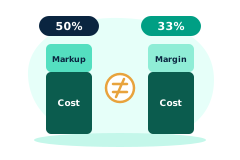
Margin & Markup Calculator
Because a 50% markup and a 50% margin are not the same number, and one of them is lying to you.
Open →
How to Start a Staffing Agency
Launch without signing a five-figure software contract before your first placement.
Open →
Staffing Payroll Tax Guide
FICA, FUTA, SUTA, and the acronyms that quietly eat your margin.
Open →Run the Whole Vocabulary in One Platform
Bill rates, margins, placements, and payroll, all in one system at $0 recruiter seats.