
Worker Reliability
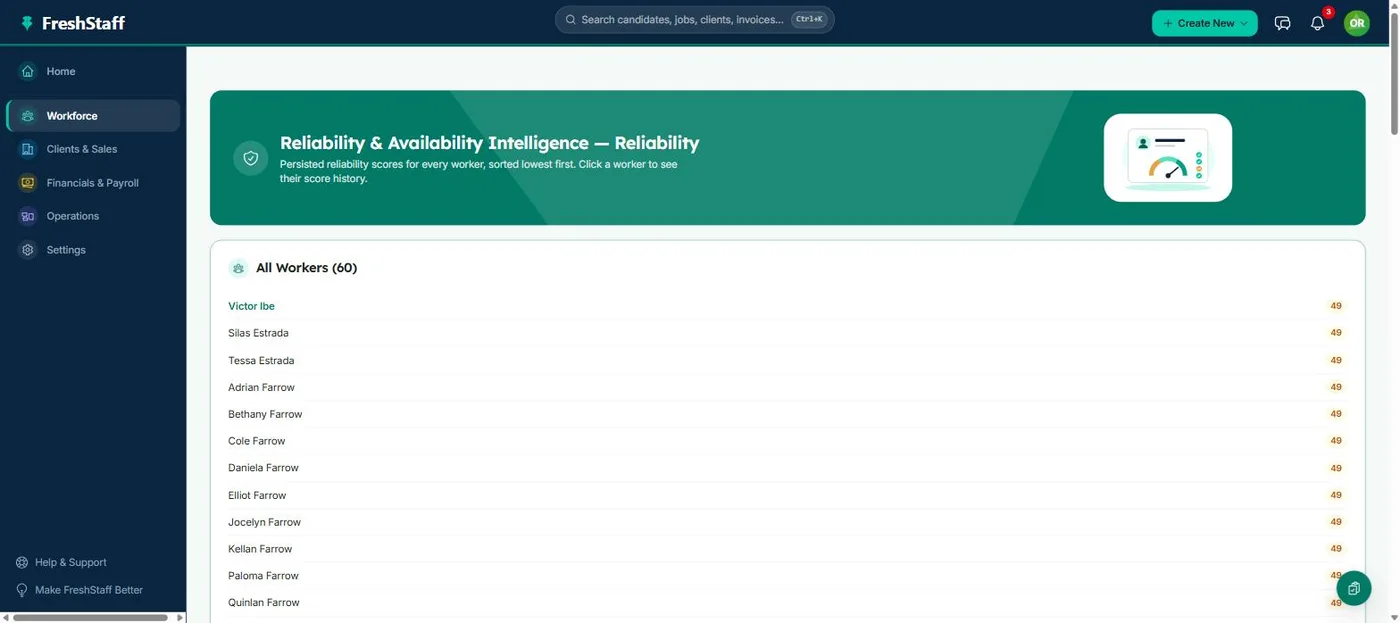
A weighted reliability score for every worker, computed from real attendance and placement history, so you can see who's dependable before a client finds out the hard way.

A worker who no-shows on day one of a placement costs a staffing agency more than the shift. It costs the client relationship. Worker Reliability turns scattered attendance signals already sitting in FreshStaff into one clear, explainable score, visible right where you're already deciding who to place.
Why staffing teams need it
Recruiters usually judge reliability from memory: 'I think this worker showed up late a few times.' That doesn't scale past a handful of names, and it quietly favors whoever a recruiter happens to remember best. Meanwhile the real signals, time entry punctuality, completed versus cancelled placements, no-show history, already exist in the system. They just were never put together in one place.
Without a reliability signal, a client-facing placement decision is really a guess dressed up as judgment. Worker Reliability replaces that guess with a number you can point to and back up.
How FreshStaff builds it
FreshStaff pulls each worker's time entry punctuality, completed placement rate, and no-show or cancellation history, then combines them into one weighted score with an attendance risk band, low, medium, or high, computed the same way every time, not a model making its own judgment call.
The score shows up as a badge right on placement records, and a full reliability report breaks it down into its underlying factors, so a manager isn't just told 'medium risk' without knowing why.
Nightly trend history and a 14-day availability forecast
Every night, FreshStaff stores a new snapshot of each worker's reliability score, never overwriting the last one, so you can see whether a score is climbing or sliding, not just where it sits today. The same nightly run projects each worker's availability 14 days forward, with the most confidence in the days closest to today.
Copilot reads both. A reliability score that drops 15 or more points between snapshots, or a worker with no forecasted available days in the next week, becomes a priority in the daily list with a plain reason attached. From there, Replace Worker suggests an available substitute with a strong score, Adjust Schedule flags the placement for a recruiter to reassign, and Alert Manager notifies the branch. Every action is recorded in the audit trail.
How It Works
- 1
Every time entry, placement completion, and no-show a worker has on record feeds into the scoring engine automatically.
- 2
Those signals combine into one weighted score and a risk band: low, medium, or high.
- 3
The score appears as a badge on the worker's placement record, with a link through to the full reliability report.
- 4
The reliability report breaks the score into its component factors, so the reasoning is never hidden behind a bare number.
Why It Matters
A visible, explainable reliability score lets a recruiter make a client-facing placement decision with actual evidence instead of memory.
Because the score is computed the same way for every worker, it removes the recency and familiarity bias that comes from judging reliability by feel.
In the product
Worker Reliability in FreshStaff
How Worker Reliability Compares
| Capability | FreshStaff | Legacy ATS | Manual Processes |
|---|---|---|---|
| Reliability signal | Weighted score, computed from real history | Not available | Recruiter's memory |
| Attendance risk visibility | Badge on every placement record | N/A | Only if someone asks |
| Explainability | Full factor breakdown on request | N/A | None |
| Consistency across recruiters | Same scoring for every worker | N/A | Varies by who's asked |
Keep Exploring
All 29 features →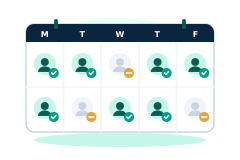
Worker Availability
See which workers are actually free today before you ever open a job order.
Learn more →
Analytics
Real-time dashboards for fill rate, compliance, and velocity.
Learn more →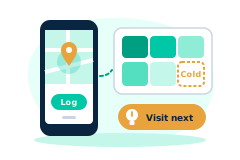
Client Intelligence Hub
GPS auto-capture, territory heatmaps, route planning, and an AI sales assistant for field reps.
Learn more →