
Bullhorn Alternatives in 2026: What to Actually Compare Before You Switch
Thinking about leaving Bullhorn? What actually differs between staffing platforms, pricing, native payroll, and contract terms, so you can compare on substance.
Ed Burtle · · 3 min read
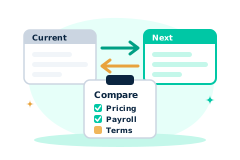
Bullhorn is one of the most widely used platforms in staffing, and for a lot of agencies it works fine. But it's also one of the most common platforms agencies say they're evaluating alternatives to, usually for one of three reasons: per-seat pricing that grows with headcount instead of revenue, a multi-year contract signed before the agency knew its real usage pattern, or a back office that requires stitching together separate systems for payroll and compliance. If any of that sounds familiar, here's what's actually worth comparing before you commit to a switch.
Start With the Pricing Model, Not the Price
The first thing to understand about any Bullhorn alternative is how it prices, not just what the number is. Bullhorn's published pricing runs roughly $99 to $315+ per seat per month depending on tier, and it bills every logged-in user, recruiter, coordinator, admin, whether they're actively working that month or not. That model rewards a lean internal team and penalizes agencies that staff up during growth.
Most alternatives fall into one of two camps: platforms that also price per seat (so you're trading one per-seat vendor for another), and platforms that price based on usage, like active placements or billed hours, which decouples your software cost from your headcount. That distinction matters more than almost any feature comparison, because it determines whether your software bill grows with your team or with your revenue.
What to Compare, Beyond the Sales Deck
Native payroll and compliance vs. third-party integration. Bullhorn is an ATS/CRM first; gross-to-net payroll, multi-state tax withholding, and ACA tracking typically require a separate vendor or add-on module. Ask any alternative directly whether payroll and ACA tracking (including 1094-C/1095-C generation) run natively on the platform, or whether you'd still be reconciling data between two systems.
Contract terms. Bullhorn is typically sold on a 1 to 3 year contract. A platform you haven't used yet at your actual placement volume is a real commitment to make sight-unseen. Month-to-month billing, or at minimum a short initial term, matters more than most agencies weigh it early in an evaluation.
Interface age and consistency. Several established staffing platforms run a genuinely modern, unified web interface. Others are built on an older core, sometimes a legacy desktop application with a newer web layer bolted on, where feature parity between the old and new isn't complete yet. Ask to see the actual day-to-day screens a recruiter and a payroll admin would use, not just a sales demo of the flashiest feature.
Migration support. Moving historical placement records, compliance documents, and client data off Bullhorn is real work. Ask what the migration process looks like concretely, what it costs, and how long it typically takes, before you're mid-migration and finding out.
The Honest Landscape
A few platforms come up repeatedly in Bullhorn-alternative searches, each with a different tradeoff:
- Avionté is a long-established staffing platform with a broad feature set, but it doesn't publish pricing (expect a custom quote) and its interface is a legacy desktop/web hybrid rather than a single modern application. See FreshStaff vs. Avionté for a detailed breakdown.
- TempWorks also requires a custom quote rather than publishing pricing, and currently runs two separate products, Enterprise (an older Windows desktop application) and Beyond (a newer web platform still gaining feature parity with Enterprise), rather than one unified platform. See FreshStaff vs. TempWorks.
- FreshStaff publishes its pricing directly on the homepage ($149/month base plus $6/month per Active Placement, unlimited free internal team seats), runs native payroll and ACA tracking on the same platform as the ATS, and bills month-to-month. See the full breakdown at FreshStaff vs. Bullhorn.
How to Actually Decide
Don't evaluate alternatives on feature checklists alone, most staffing platforms check similar boxes on paper. Instead, run each finalist through the same scenario: your actual internal headcount, your actual active placement volume, whether you need native payroll or are fine integrating a separate one, and how long you're comfortable being locked into a contract before you've used the platform at scale. The answer that looks cheapest in a sales deck isn't always the one that's cheapest for your specific agency, and the only way to know is to run your own numbers against a published or itemized quote, not a marketing number.
For broader context on staffing technology evaluation criteria, TechServe Alliance publishes resources aimed at the IT and engineering staffing sector specifically.

Which Staffing ATS Fits You?
An honest quiz, we’ll even tell you when the answer isn’t us.
Run your numbers →About the Author
Ed Burtle
Ed Burtle is the founder of FreshStaff. He's spent 20+ years in enterprise IT, network administration, and cybersecurity across government, military, and private-sector roles, including building multiple employee onboarding systems and consulting on IT infrastructure for staffing agencies like 1st Choice Personnel and East Texas Staffing. He holds a CISSP (Certified Information Systems Security Professional) certification and is a U.S. Air Force veteran. That background, building and securing large-scale systems where reliability and compliance aren't optional for both government systems and the staffing agencies that actually run on this kind of software, shapes how FreshStaff is built: real encryption, real audit logging, and a payroll and compliance engine held to the same standard as the systems he's spent his career on, not bolted on as an afterthought.
More about FreshStaff →Related guides
How Much Does Staffing Software Really Cost in 2026?
Per-seat pricing, custom quotes, and add-ons make staffing software hard to compare. How to figure out what you'd actually pay before talking to a salesperson.
Read the guide →
How to Switch ATS Platforms Without Losing Your Data: A Migration Checklist
Migration risk is the top reason agencies stay on software they've outgrown. What actually goes wrong in an ATS migration, and the checklist that prevents it.
Read the guide →
Temp-to-Hire vs. Direct Placement: Which Model Fits Your Client?
The same open req can be filled two different ways. How temp-to-hire and direct placement differ for your client and cash flow, and running both on one system.
Read the guide →