
Temp-to-Hire vs. Direct Placement: Which Model Fits Your Client?
The same open req can be filled two different ways. How temp-to-hire and direct placement differ for your client and cash flow, and running both on one system.
Ed Burtle · · 3 min read
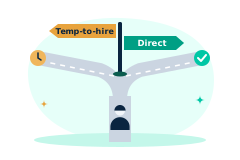
A client with an open seat doesn't usually come to you asking for "temp-to-hire" or "direct placement" by name, they come to you with a hiring problem. Picking the right contractual path to solve it is part of the value a good agency provides. The two models can fill the exact same seat with the exact same candidate and still produce very different outcomes for risk, cost, and speed, for both your client and your own agency.
What Temp-to-Hire Actually Means
In a temp-to-hire arrangement, the worker is your agency's employee, not the client's, for a defined trial period before an optional conversion to the client's headcount. You run payroll, you carry the employment risk and the compliance obligations, and the client pays an hourly bill rate for the worker's time. If it's not a fit, the assignment ends without either side going through a termination process. If it is, the client typically pays a conversion fee to bring the worker onto their own payroll, or the arrangement simply continues on your books indefinitely.
What Direct Placement Actually Means
Direct placement (also called direct hire) skips the trial period entirely: the worker becomes the client's employee from day one, and your agency's role ends once the placement fee, usually a percentage of first-year salary, is collected. There's no ongoing payroll relationship, no bill rate, and no assignment to manage. Your revenue on that placement is a single event rather than a recurring stream.
The Trade-offs for Your Client
- Risk tolerance. Temp-to-hire lets a client evaluate real, on-the-job performance before committing to a hire. Direct placement asks them to commit based on interviews alone.
- Urgency and role type. Seats that need to be filled immediately, especially hourly and light-industrial roles, lean temp-to-hire. Senior, specialized, or confidential searches lean direct placement, where a trial period isn't practical or expected.
- Total cost. A client comparing the two only on the headline number will misjudge them, temp-to-hire's bill-rate markup accrues over the trial period, while direct placement's fee is paid once, but there's no universal answer for which is cheaper; it depends entirely on trial length and how the roles compare.
The Trade-offs for Your Agency's Cash Flow
This is the trade-off staffing agency owners feel most directly. Direct placement fees land as a lump sum, good for cash flow timing but entirely dependent on the search actually closing. Temp-to-hire bills incrementally, hours worked, invoice sent, payment collected, which smooths revenue but means your agency is carrying payroll and compliance risk on that worker the whole time they're on assignment. Most agencies running both models aren't choosing one over the other, they're matching the model to the specific req and running a blended book of business.
Running Both Models Without Two Different Systems
The operational failure point isn't picking the wrong model, it's running both models on tooling that only really supports one. If your ATS treats every job order the same way, you end up tracking direct-placement fees in a spreadsheet next to a system built for hourly billing, or the reverse. FreshStaff tags every job order with its employment type, temp, contract, or direct-hire, and keeps one placement record per worker with a full status and timeline that stays attached across the engagement, whichever model it is. Client invoicing runs both hourly line items and one-time placement fees on the same invoice, so a mixed-model client relationship doesn't require two billing processes. All of it runs on the same $149/month flat base with unlimited free Internal Team Seats, whether a desk is running temp, contract-to-hire, or direct-hire searches. More detail is on the Temp-to-Hire and Permanent Placement pages.
The Bottom Line
Temp-to-hire and direct placement aren't competing philosophies, they're two tools for two different situations, and the agencies that grow fastest are usually the ones that can offer a client whichever one actually fits the req, not just whichever one their software happens to be built for.

Conversion Fee Calculator
What to charge when a client “accidentally” hires your temp.
Run your numbers →About the Author
Ed Burtle
Ed Burtle is the founder of FreshStaff. He's spent 20+ years in enterprise IT, network administration, and cybersecurity across government, military, and private-sector roles, including building multiple employee onboarding systems and consulting on IT infrastructure for staffing agencies like 1st Choice Personnel and East Texas Staffing. He holds a CISSP (Certified Information Systems Security Professional) certification and is a U.S. Air Force veteran. That background, building and securing large-scale systems where reliability and compliance aren't optional for both government systems and the staffing agencies that actually run on this kind of software, shapes how FreshStaff is built: real encryption, real audit logging, and a payroll and compliance engine held to the same standard as the systems he's spent his career on, not bolted on as an afterthought.
More about FreshStaff →Related guides

Staffing Agency KPIs: The Metrics That Actually Predict Growth
Placements and revenue booked tell you what already happened. The operational metrics that tell you what's about to happen, before most agencies notice.
Read the guide →
Why Modern Staffing Needs Automation
Manual, spreadsheet-driven staffing can't keep pace with hiring volume. Why letting AI handle onboarding, compliance, and scheduling is now table stakes.
Read the guide →
How to Manage ACA Compliance for Staffing Agencies
How to manage ACA compliance for staffing agencies: full-time status for variable-hour and seasonal temps, look-back measurement periods, affordable offers of coverage, and where spreadsheet tracking breaks down.
Read the guide →