
How Much Does Staffing Software Really Cost in 2026?
Per-seat pricing, custom quotes, and add-ons make staffing software hard to compare. How to figure out what you'd actually pay before talking to a salesperson.
Ed Burtle · · 4 min read
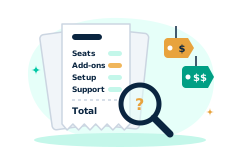
Ask five staffing agency owners what they pay for their ATS and payroll software, and you'll likely get five different answers, not because their agencies are that different, but because staffing software pricing is genuinely hard to compare. Some platforms publish a number. Most don't. Some charge per seat. Some charge per placement. Some bundle payroll in. Most don't. By the time you've had three sales calls, you're comparing quotes that aren't structured the same way at all.
Why Staffing Software Pricing Is So Hard to Compare
The core problem is that most legacy staffing platforms don't publish pricing at all. You submit a form, a sales rep calls, and the number you get depends on your headcount, your placement volume, which modules you ask for, and often how the negotiation goes. That's not unusual for enterprise software in general, but it makes apples-to-apples comparison nearly impossible for an agency owner trying to budget before ever getting on a call.
The second problem is that the unit of pricing varies. Some platforms charge per seat, meaning every recruiter, coordinator, and admin login adds to the bill, whether that person is actively working that month or not. Others charge based on usage, like the number of workers actually out on active job assignments. These two models can produce wildly different totals for the same agency, and a quote that looks cheap on the surface can turn out to be the more expensive option once your whole office is counted.
The Real Cost Isn't Just the Base Price
The quoted number is rarely the full story. Three costs show up after the sales call that agencies frequently don't budget for upfront:
- Per-seat fees that scale with your team, not your business. If pricing is per seat, growing your internal team, hiring another coordinator, adding a branch manager, bringing on a part-time recruiter, increases your software bill even if your placement volume doesn't move. That's a strange incentive: software that gets more expensive the more people you hire to run your agency.
- Add-on modules for things you'd assume were included. Payroll, tax withholding, ACA tracking, client and worker portals, and a candidate LMS are core to running a staffing agency, but on many legacy platforms they're separate modules with separate fees, or require a third-party integration entirely. A quote that only covers the ATS/CRM core can end up 30-50% higher once the back office is added in.
- Migration and implementation fees. Moving off an existing ATS isn't free on most platforms. Data migration, historical placement records, compliance documents, and configuration setup often carry a one-time fee that can run into the thousands of dollars, on top of whatever the ongoing subscription costs.
What to Actually Ask a Vendor Before You Get a Quote
A few direct questions cut through most of the ambiguity:
- Is pricing per seat, per placement, or a flat platform fee? What exactly counts as a billable unit?
- Does the base price include payroll and tax withholding, or is that a separate module or third-party integration?
- Is ACA tracking included, and does it handle the actual IRS forms (1094-C/1095-C), or just eligibility flags?
- Are client and worker portals included, or an add-on?
- Is there a contract term, and what does cancellation actually look like?
- What does data migration cost, and how long does it typically take?
Any vendor that can't answer these clearly before a formal quote is a signal worth paying attention to.
Two Pricing Models, One Real Difference
The clearest dividing line in staffing software today is per-seat pricing versus usage-based pricing. Per-seat pricing punishes agencies for having a well-staffed internal team. Usage-based pricing, tied to something like active placements rather than logins, scales with the part of the business that actually generates revenue.
FreshStaff prices this way deliberately: a flat $149/month base fee that includes unlimited internal team seats and every feature (ATS, CRM, native payroll, ACA tracking, portals, and the candidate LMS), plus $6/month per Active Placement, a worker who actually had a pay stub, logged hours, or an active job order that billing cycle. Full details are on the pricing page, and a side-by-side breakdown against specific platforms is on the comparison hub, including FreshStaff vs. Bullhorn, FreshStaff vs. Avionté, and FreshStaff vs. TempWorks.
The Bottom Line
Don't evaluate staffing software on the first number you're quoted. Ask what's actually included, ask what the billable unit is, and run the math for your agency's actual headcount and placement volume, not the vendor's example scenario. A platform that looks more expensive per seat can end up cheaper once payroll, ACA tracking, and portals are added in elsewhere. The only way to know is to ask the questions above before you sign anything.
For general benchmarking on the staffing industry's operating costs and technology adoption, see the American Staffing Association's research and resources.

ATS ROI Calculator
See exactly how much your legacy ATS overcharges you for seats that didn’t place anyone.
Run your numbers →About the Author
Ed Burtle
Ed Burtle is the founder of FreshStaff. He's spent 20+ years in enterprise IT, network administration, and cybersecurity across government, military, and private-sector roles, including building multiple employee onboarding systems and consulting on IT infrastructure for staffing agencies like 1st Choice Personnel and East Texas Staffing. He holds a CISSP (Certified Information Systems Security Professional) certification and is a U.S. Air Force veteran. That background, building and securing large-scale systems where reliability and compliance aren't optional for both government systems and the staffing agencies that actually run on this kind of software, shapes how FreshStaff is built: real encryption, real audit logging, and a payroll and compliance engine held to the same standard as the systems he's spent his career on, not bolted on as an afterthought.
More about FreshStaff →Related guides
Bullhorn Alternatives in 2026: What to Actually Compare Before You Switch
Thinking about leaving Bullhorn? What actually differs between staffing platforms, pricing, native payroll, and contract terms, so you can compare on substance.
Read the guide →
How to Manage ACA Compliance for Staffing Agencies
How to manage ACA compliance for staffing agencies: full-time status for variable-hour and seasonal temps, look-back measurement periods, affordable offers of coverage, and where spreadsheet tracking breaks down.
Read the guide →
How to Switch ATS Platforms Without Losing Your Data: A Migration Checklist
Migration risk is the top reason agencies stay on software they've outgrown. What actually goes wrong in an ATS migration, and the checklist that prevents it.
Read the guide →