
How AI Candidate Matching Cuts Time-to-Fill for Staffing Agencies
Time-to-fill determines whether a staffing agency wins or loses a client. How AI candidate matching shrinks it, and what to look for before trusting a tool.
Ed Burtle · · 3 min read
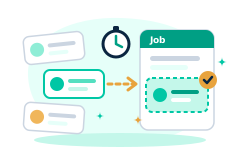
Every staffing agency lives and dies by one number: how fast a req gets filled with someone who actually shows up and does the job. Clients forgive a lot of things: a slightly higher bill rate, an imperfect onboarding experience. But they rarely forgive a role that sits open for three weeks while a recruiter manually sorts through résumés. Time-to-fill isn't just an internal efficiency metric. It's the metric your client is silently scoring you on every time they consider switching vendors.
That's exactly why AI-powered candidate matching has moved from "nice to have" to table stakes for agencies that want to keep growing. Not because AI is a buzzword clients want to hear, but because the mechanics of matching a candidate to a job are a genuinely hard search problem, and search problems are where AI actually earns its keep.
Why Manual Matching Doesn't Scale
A recruiter manually matching candidates to jobs is running a mental checklist: right skills, right certifications, right availability, right commute distance, right pay expectations, and (the part that's hardest to keep in your head) right fit based on how similar placements have gone before. That last piece is where experienced recruiters genuinely outperform a spreadsheet. The problem is that this checklist has to run for every open req, against every candidate in the pool, every single day new people apply or new jobs open.
At ten open reqs and a few hundred candidates, that's manageable. At fifty open reqs across multiple branches, it isn't. Recruiters start triaging by recency instead of relevance: the last ten résumés that came in, not the best ten in the whole pool. That happens because there simply isn't time to re-scan the entire candidate base against every job every day. Good candidates go stale in the system not because they were a bad fit, but because nobody had time to look at them again once a new req opened three weeks later.
What AI Matching Actually Does Differently
The useful version of AI matching isn't a black box that "picks a winner." It's a system that continuously re-scores the entire candidate pool against the entire set of open jobs, every time either side changes: a new application comes in, a job's requirements get edited, a candidate updates their availability. That re-scoring is the part a human can't do at scale: running hundreds of candidates against dozens of jobs, every day, without any of them going stale.
Done well, this surfaces two things a purely manual process misses constantly:
- The good candidate from three weeks ago who's still a fit for a job that opened today. Nobody has to remember they exist. The system already re-checked them.
- The strong second-choice candidate for a role the top match just turned down. Instead of starting the search over, the recruiter already has a ranked list of who's next.
Neither of these is exotic. They're both just "don't let good matches expire," applied consistently instead of only when a recruiter happens to have spare time.
What to Actually Look For
If you're evaluating whether a platform's "AI matching" is worth trusting with your pipeline, the questions worth asking aren't about the algorithm. They're about what happens when it's wrong:
- Can a recruiter see why a match was ranked the way it was? A score with no explanation is a score you can't argue with or correct.
- Does it re-score automatically, or only when someone manually re-runs a search? Stale scoring defeats the entire point.
- Does it degrade honestly when data is missing? A candidate with an incomplete profile shouldn't get a fabricated high score. It should get flagged as under-qualified-to-judge, not silently ranked as a strong match.
- Can a recruiter override it without a fight? The system should make the recruiter faster, not replace their judgment on the calls that matter.
The Real Payoff
The agencies that get the most out of AI matching aren't the ones that let it run unsupervised. They're the ones that use it to stop losing good candidates to time: the ones who apply on a Tuesday for a role that doesn't open until three weeks later, and would have been forgotten by then in a manual process. Shrinking time-to-fill isn't really about searching faster. It's about not letting the search have to start from zero every single time.
Job Description Generator
Warehouse and light-industrial posts, minus the blank-page stare.
Run your numbers →About the Author
Ed Burtle
Ed Burtle is the founder of FreshStaff. He's spent 20+ years in enterprise IT, network administration, and cybersecurity across government, military, and private-sector roles, including building multiple employee onboarding systems and consulting on IT infrastructure for staffing agencies like 1st Choice Personnel and East Texas Staffing. He holds a CISSP (Certified Information Systems Security Professional) certification and is a U.S. Air Force veteran. That background, building and securing large-scale systems where reliability and compliance aren't optional for both government systems and the staffing agencies that actually run on this kind of software, shapes how FreshStaff is built: real encryption, real audit logging, and a payroll and compliance engine held to the same standard as the systems he's spent his career on, not bolted on as an afterthought.
More about FreshStaff →Related guides

Why Modern Staffing Needs Automation
Manual, spreadsheet-driven staffing can't keep pace with hiring volume. Why letting AI handle onboarding, compliance, and scheduling is now table stakes.
Read the guide →
Staffing Agency KPIs: The Metrics That Actually Predict Growth
Placements and revenue booked tell you what already happened. The operational metrics that tell you what's about to happen, before most agencies notice.
Read the guide →
How to Switch ATS Platforms Without Losing Your Data: A Migration Checklist
Migration risk is the top reason agencies stay on software they've outgrown. What actually goes wrong in an ATS migration, and the checklist that prevents it.
Read the guide →