
How Multi-State Payroll Tax Works for Staffing Agencies
Placing workers across state lines turns payroll into a jurisdiction problem. How withholding, SUTA, and reciprocity interact, and where tracking breaks.
Ed Burtle · · 3 min read

Most employers deal with payroll tax in one state. Staffing agencies rarely get that luxury, a single branch can place workers across several client states in the same pay cycle, and a worker can live in one state while working in another. None of this changes what's legally owed, but it multiplies the number of jurisdictions, rates, and forms a payroll process has to get right at the same time. This is a general overview of how the pieces fit together, not tax or legal advice, current rates, thresholds, and reciprocity agreements should always be confirmed against your state's revenue department or a qualified payroll tax professional.
Why Staffing Hits This Faster Than Other Employers
A typical employer registers for payroll tax in one or two states and rarely revisits it. A staffing agency's multi-state exposure grows with every new client relationship in a new state, every worker placed across a state line, and every branch office opened. The employer-of-record question, is a worker's income tax withholding based on where they live, where they work, or both, comes up constantly in staffing in a way it simply doesn't for a company with one office and a stable in-state workforce.
The Moving Pieces
- State income tax withholding. Each state that requires it sets its own withholding tables, and some states have none at all. The default rule is generally to withhold based on where the work is physically performed, not where the employee lives.
- Reciprocity agreements. A handful of neighboring states have agreements letting a resident of one state work in the other without double withholding, but only if the right exemption form is filed. Missing that form means a worker gets withheld in both states until it's corrected.
- SUTA (state unemployment). Unemployment insurance is generally tied to the state where the work is performed, with its own wage base and agency-specific experience rate that changes annually based on claims history, not a flat number you can hardcode once.
- FUTA (federal unemployment). Federal, flat-rate, and the one piece of this that doesn't vary by state, though it interacts with SUTA credits in ways that matter for the final effective rate.
Where Manual Multi-State Payroll Breaks Down
Getting one state right is straightforward. Getting five or ten right, every pay cycle, for a workforce whose composition changes weekly as placements start and end, is where spreadsheet-based payroll consistently fails: a new state registration gets missed until a client relationship starts there, a reciprocity exemption form never gets filed, a SUTA rate update from the state agency doesn't make it into the calculation until someone happens to notice, or a worker's withholding state doesn't get updated when they move to a new assignment across a state line. None of these are hard problems individually, they're a volume problem, the same handful of easy-to-miss steps repeated across every state, every worker, every cycle.
What Actually Reduces Risk
The fix isn't finding a better spreadsheet formula, it's running withholding, SUTA, and FUTA calculations as native logic tied to each placement's actual work state, so the correct jurisdiction's rules apply automatically as placements start, move, and end, instead of depending on someone manually re-checking each worker's state assignment every cycle.
FreshStaff's native payroll engine runs IRS percentage-method federal withholding for every worker, with built-in state withholding modules for Georgia, South Carolina, Florida, Alabama, North Carolina, and Texas, and a disclosed safe fallback for states outside that native set so a payroll run never silently applies the wrong state's logic. FICA is calculated with the real Social Security wage-base cap and the 0.9% additional Medicare surtax past $200k of a worker's year-to-date wages, and SUTA runs on an employer-configurable rate and wage base with flat-rate FUTA, all inside the same platform that's already tracking each worker's placement and timecard hours. More detail is on the Native Payroll & Compliance page.
The Bottom Line
Multi-state payroll tax for a staffing agency isn't harder because the rules themselves are exotic, it's harder because the number of jurisdictions you're responsible for scales with your placement volume, not your headcount. Whatever system runs your payroll, the real question is whether it applies the right state's rules automatically as a worker's assignment state changes, or whether that's a manual lookup someone has to remember to do correctly every single cycle.
For authoritative and current guidance, confirm rates, thresholds, and reciprocity rules with your state's department of revenue and a qualified payroll tax advisor for decisions specific to your agency.
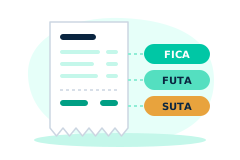
Staffing Payroll Tax Guide
FICA, FUTA, SUTA, and the acronyms that quietly eat your margin.
Run your numbers →About the Author
Ed Burtle
Ed Burtle is the founder of FreshStaff. He's spent 20+ years in enterprise IT, network administration, and cybersecurity across government, military, and private-sector roles, including building multiple employee onboarding systems and consulting on IT infrastructure for staffing agencies like 1st Choice Personnel and East Texas Staffing. He holds a CISSP (Certified Information Systems Security Professional) certification and is a U.S. Air Force veteran. That background, building and securing large-scale systems where reliability and compliance aren't optional for both government systems and the staffing agencies that actually run on this kind of software, shapes how FreshStaff is built: real encryption, real audit logging, and a payroll and compliance engine held to the same standard as the systems he's spent his career on, not bolted on as an afterthought.
More about FreshStaff →Related guides

How to Manage ACA Compliance for Staffing Agencies
How to manage ACA compliance for staffing agencies: full-time status for variable-hour and seasonal temps, look-back measurement periods, affordable offers of coverage, and where spreadsheet tracking breaks down.
Read the guide →
How Much Does Staffing Software Really Cost in 2026?
Per-seat pricing, custom quotes, and add-ons make staffing software hard to compare. How to figure out what you'd actually pay before talking to a salesperson.
Read the guide →
Why Modern Staffing Needs Automation
Manual, spreadsheet-driven staffing can't keep pace with hiring volume. Why letting AI handle onboarding, compliance, and scheduling is now table stakes.
Read the guide →